Friday, March 26, 2010

Road Rage and Retributive Justice


Road Rage: a symptom of our times. Who hasn't at one time or another been subject to road rage, whether as a victim or perpretrator? And what is there in the human condition that sometimes makes us raging monsters when behind the wheel of a powerful vehicle? I read recently of a man who was sentenced to life in prison, after running over three people and killing a fourth.
And who hasn't had the experience of being in front of a driver madly expressing his frustration with our supposed dawdling along, when in fact we're unable to go any faster than the vehicle or vehicles in front of us? For whatever reason I decided long ago that it's better to arrive somewhere fifteen minutes late than to risk life and limb to get there immediately. A type B driver gets there in almost the same time, and with his blood pressure down to life-enhancing levels. I've tried to convey this philosophy to anyone would listen. After all, what're a few minutes in the scope of eternity? Better to chill out and arrive alive.
And as for taking out revenge or “getting even” with someone behind the wheel of another vehicle, I can hardly think of a better way to court disaster. Better to take things philosophically and pull over at the first opportunity, letting that steroid- or coke-enraged madman on your tail go on to this own individual destination–or destiny. Let the laws of karma deal with the situation. Sometimes they work quicker than we'd think.
A number of years ago I was driving my old ‘74 Peugeot north out of Key West to visit some friends up the Keys. That afternoon there was one of the famous toad-strangling thunderstorms that the Keys are famous for. The visibility ahead was maybe 60 feet, in between sweeps of the wiper blades. I slowed down to what I thought was a reasonable 45 miles per hour. Suddenly in the rear view mirror I see a huge pickup truck, honking its horn and flashing its lights. I’m thinking I can’t even see the shoulder to pull over, and this guy’s following so close I don’t even dare slow down to try to pull over or he’ll run right into me.
Soon the road opened up to two lanes, and as the truck passed, the driver gave me a traditional one-fingered salute. I’m thinking that guy must be out of his mind. There’s an inch of water on the road, and even worse, he’s towing a huge utility trailer full of stuff. And he’s doing well over 60.
A few minutes later the rain began to abate, and I noticed what looked like a pair of lights in the mangroves ahead off to the right. Sure enough, it was Hurry Harry: his rig had hydroplaned on the watery highway. He’d lost control, the trailer had jack-knifed, and the whole rig spun backwards into the brackish swamp, with the truck facing the road and the trailer at a very odd 90-plus degree angle off to the side.
I gave the fellow a tip o’ the hat as I drove by. And oh yeah, I called the highway patrol when I got where I was going. Told them they’d need a wrecker to pull the guy out.

Thursday, February 25, 2010

Haiti: How to Rebuild?


Above is a recent photo of a house in Belize that we rented for a few months back in 1983. This house is around 40 years old, and is still in good shape. It sits on a concrete slab, but the house itself contains no concrete and no lumber. (The only wood products used are a few light pieces of trim around the windows and doors.) The house is made of light-weight metal studs, some of which you can see protruding from the gable end on the left side. The roof is metal, the outside walls are thin cement-based composite board with an even thinner coating of stucco. The inside walls are gypsum drywall. The total package is strong, light, waterproof, and wind- and fire-resistant.

The situation in Haiti: hundreds of thousands of people are now homeless. The UN has decided, wisely, that providing tents for these people is a waste of money. Instead they're trying to provide them with metal roofing to construct makeshift shelters. Ultimately the answer may be structures like the one pictured above. A metal roof supported by a metal framework would provide durable shelter from the rains which will be starting by June, and would also be light enough not to present a threat in the event of another earthquake.

As long as the walls were firmly anchored, the floor could be an afterthought, installed later when the owner had enough time and resources to do so. Even the walls could be temporary, eventually replaced by a lath or hardboard covered by a type of tabby.

Given a workable design and a few basic materials, coupled with the average Haitian's ingenuity in scrounging scrap materials, which should be available in abundance, there's a chance that this type of construction might be the answer to Haiti's need for permanent, safe housing. Just a thought....

Wednesday, February 3, 2010

Haiti: Hope and Horror

At left, ruins of the Hotel Montana in Port-au-Prince, Haiti. A number of Americans were among those killed or injured in the collapse of the venerable structure. Still missing is volunteer Walt Ratterman of Knightsbridge International, a California-based charity, who was working on a solar power project in Haiti.
(At one time we lived for several months on the street leading up to the Montana. I remember that Mike Wallace, the TV newscaster, had a house on that street, although we never saw him. We'd talked about going back to Haiti earlier this year, and we would have stayed at the Montana, however briefly, for old time's sake.)
The horror of the situation has been widely reported to the world, and teams of aid workers from all over the planet have arrived and performed miracles of service and sacrifice. At home and abroad people have opened their wallets, and food and medical aid are now coming into the country. There have been a few problems: the specter of food riots, and Haitian bureaucrats holding up food and medical supplies at the airport with their ubiquitous red tape and desire to levy some kind of a "tax", seemingly oblivious to the suffering of their countrymen.
It's to the advantage of those still suffering that the international press is present, although now that some of the horror of the situation is no longer novel, the New York Times has actually run an article on Anderson Cooper and Sanjay Gupta's choice of clothing.
Gupta in particular should be commended for staying behind at a field hospital, when UN authorities had ordered all medical personnel to leave the wounded behind, for purported security reasons.
Cooper got a minor "reality check" later in the week, reporting "on the ongoing process of an apparently organized effort run by local authorities to gather up the bodies littering the streets, collect them in dump trucks, then transport them out of the city, where they would be dumped in mass graves. The mass graves are shown as mounds of dirt in the hills outside the city, appear to be relatively shallow and hold no information to identify the dead other than the bodies themselves."
Grilling a (female) Haitian official American press-style on the situation, he was unable to elicit a "straight" answer.
If he'd been briefed on the details of Haitian folk culture, he would have known that many Haitians believe that bodies must be properly buried and remembered by relatives and family so their spirits can pass on to heaven. In Voodoo, some believe that improper burials can trap spirits between two worlds. A proper burial is necessary for a certain life-force to leave the body gradually, lest the soul be trapped in a sort of underground limbo. (This belief was described in ethnobotanist Wade Davis's book, The Serpent and the Rainbow, which was made into a movie several years ago.) It would be unthinkable for a government official to admit that such a thing had been allowed to happen, even in the interests of sanitation and prevention of disease.
As the relief efforts continue, we can sure that unforeseen problems will crop up. We can only hope that somehow the Haitian people, including expatriates, will summon up the courage and wisdom to straighten out their country themselves.
And let's fact it--thirty years ago Haiti was already overpopulated and an ecological disaster. Europeans and North Americans have been sensibly limiting the size of their families for years. It's neither racism nor flouting God's law to suggest that it's high time for Haitians to do likewise.

Friday, January 22, 2010

Earthquakes in Haiti


I discovered an old book, Geologie d'Haiti, that I bought in Haiti around 1981. It appears to be a textbook for an introductory geology course. In light of recent events the section on seismology was interesting. It begins with a brief description of a seismograph and a definition of earthquakes in general, then gives a description of earthquake damages to be expected according to the Rossi-Forel scale. The language is a little quaint, translated from French.

There are devices for recording earthquakes. They are seismographs, which are essentially a sheet of paper wound on a cylinder that rotates. A needle draws a line on the cylinder. In times of calm, this is a straight line, but when the earth trembles, it becomes sinuous.
Earthquakes, like volcanoes, are due to internal operations of the globe. Earthquakes correspond to ruptures of equilibrium in different compartments of the earth.

Degree one and two: shaking recorded by some devices.
Degree three: tremors felt by people at rest.
Degree four: tremors recorded by all, with noise from doors and windows (shaking).
Degree five: in addition to previous effects: cracking ceilings, furniture oscillating.
Degree six: sleepers are awakened by the uproar and clock pendulums stop.
Degree seven: the walls have cracks.
Degree eight: old houses topple and contents are damaged.
Degree nine: panic -- buildings collapse and oscillate. Fires.
Degree ten: complete disaster: the destruction of buildings, bridges, drying up of wells.
Degree Twelve: uplift and subsidence of parts of mountains, breaking land, complete destruction.


Then it goes on to give a history of seismic events in Haiti from 1701 to 1953.
Quelques tremblements de terre historiques d'Ha'iti Some earthquakes of historic Ha'iti

In his book "Geology of the Republic of Haiti " (1924), the American geologist Wendel Woodring writes: " Earthquakes are frequent in Haiti. At the time of the colony and of the Republic, disastrous earthquakes, from time to time, have caused the complete or nearly complete destruction of Port-au-Prince, Cap-Haitian, and other cities."

Indeed our country is often the seat of earthquakes whose disastrous consequences are intensified in the cities because they are generally built on alluvial land (soft ground).


November 9, 1701. It caused the destruction of the plain Leogane (degree VI).
From November 21, 1751 to December 8, Port-au-Prince, which had just been founded, undergoes a series of shocks. It is reported that after the first shock of November 21, one house remained standing, but was in turn destroyed by the earthquake that took place on the second day (degree VIII and IX).
June 3, 1770. New quake Port-au-Prince, in the plain of Cul-de-Sac. 200 deaths in the city of Port-au-Prince. Petit-Goave and Leogane were destroyed (IX degree).
May 7, 1842. One of the most violent. It completely destroyed the cities of Cape Ha'itien, Port de Paix and Mole St. Nicolas. There were 5000 deaths in the city of Cap Haitien alone, and no building was left standing in Port de Paix (degree X).
April 8, 1860. It was felt throughout the whole southern peninsula. (V degree).
September 23, 1887. It spared nothing in Mole St. Nicolas, and its effects were felt very far to South (Jérémie, Anse-d'Hainault) (IX degree).
March 20, 1910. It shook the whole North and North-West of the country causing extensive damage (degree IV).
August 3, 1910. The whole Republic was shaken, but with a particularly marked effect in Jérémie (VII degree).
August 21, 1911. The whole country was shaken with different intensities. Gonaives, Mole St. Nicolas, Pilate, Cap-Haitien. Gros Morne were the cities hardest hit (VIII degree).
October 6, 1911. The shock was particularly strong in Puerto Rico and Dominican Republic, but it seriously damaged the city of Cerca La Source (degree X).
6 and September 7, 1912. It was general, but particularly reached the towns of Plaisance, Limbe, Grande-Riviere-du-Nord and St-Michel de I'Atalave (degree. VIII).
July 31, 1914. Very intense shock affecting Port-au-Prince and its environs. It lasted 50 seconds (VII degree).
July 26, 1917. Very strong shaking in Port-au-Prince, Cap-Haitien, Limonade (degree VI).
4 February 1918. It caused partial destruction of the Mole St. Nicolas (degree VII).
From 1909 to 1920. Several series of shocks, fortunately weak one, recorded at I'Anse-a-Veau (level III).
January 15, 1922. Quake which shook all the southern peninsula: from Jeremie to Port-au-Prince and from Jacmel to Cayes. (degree VI).
1953. L'Anse-a-Veau is again the seat of a series of tremors, but their effects are fairly localized (degree IV to VII).


Thus we see that things had been fairly quiet there for the last fifty years. Amid their many other problems and other disasters, most people had forgotten that threat from earthquakes was still a danger. On the scale given above, it looks as if the quake this month was a ten. Interesting that they don't have an eleven; at that level of destruction the details are moot.

Thursday, January 14, 2010

Bleeding Haiti


The latest reports from Haiti say that aid workers are now realizing the enormity of the logistical nightmare ahead of them.

Right now Haiti needs medical people, money and machines. The port facilities are damaged. Everything must come in through the airport.

Thankfully chaos has so far prevented Haitian bureaucrats from "doing their thing." It wasn't too long ago that there were whole warehouses full of rotting food, because Haitian customs types had the shipment held up with unfathomable red tape, while women and children were eating cakes made of mud in the same city. There's no time for that kind of nonsense now.

Unfortunately in Haiti there has been a lack of what one Haitian observer described as "organization." The Red Cross is sending in 100 "experts" to assess damages and needs. Their best approach will be to divide the damaged areas into manageable sectors and proceed accordingly.

In the meantime aid workers are fearing an eventual outbreak of violence. Added to that is the real and ongoing threat of malaria and other diseases.

Those viewing from afar can do little but pray and send whatever donation they can afford. Donations are best sent to organizations which have a proven record of getting the money to where it is needed.

Wednesday, January 13, 2010

Haiti: How Can We Help?


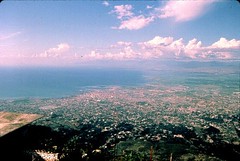
Overlook
Originally uploaded by Mangrove Mike
The situation is every bit as bad as early reports indicated.

Right now they need medical people, machines, and money.
The charities most likely to get the aid where it is needed most are the American Red Cross and your local church.

Tuesday, January 12, 2010

Haiti is Hell


"Haiti is Hell!" said the big man, throwing down a clump of dirt. "Wherever you dig on this island, if you dig deep enough, you will find Hell!" Gerard was one of the few Cap Haitien men who stayed to work on our job, after the others had left because of a wage dispute. I remembered him because of his size, the intensity of his manner, and his wild stories of Haitian magic and treasure digging.

It was because I knew his name that I noticed a month after he had left that he was still on our payroll. One of the company's most trusted bookkeepers had created a "Zombie," probably one of several, and was enriching himself at the company's expense.

Not that this behaviour was untypical. Even our own on-site timekeeper, whom we considered to be unimpeachable, bought himself a brand new Peugeot truck after the job was over, to be used as a "tap-tap."

Corruption, as in other places, is practiced from the top down in Haiti. As an unwritten law it's actually admired and emulated. This is one reason the nation has never been able to lift itself out of its cultural and economic morass, and the many ills which seem to descend on it like a curse.

Poverty, tyranny, disease, and ignorance are its recent history. Added to this is the curse of AIDS, overpopulation, political violence, drug trafficking and gang-inspired kidnappings.

This is not to say that there are not good and decent people among them. Even Sodom and Gomorrah were "spared for the sake of even ten righteous men," but I fear that today a great many of the righteous have been slain along with the wicked in Haiti.

A 7.0+ on the Richter scale earthquake doesn't ordinarily discriminate among its victims. In the countryside most of the houses are simple wooden structures with thatched roofs. In the city and "suburbs" are many substandard buildings made from concrete blocks and little if any reinforcing steel. Deaths and injuries must be substantial.

There is great suffering in poor Haiti tonight. The first news reports are slow in arriving. It will be interesting to see how the world reacts, and whether the better elements of Haitian society rise to the occasion, or whether the country sinks into further depravity and violence.

Well-intentioned Americans must decide what they can best do to help the afflicted, without unduly enriching the inevitable middlemen and agents even now planning how they will "tax" the largesse about to be disbursed.

The sadness about to be revealed in Haiti, while it holds our attention, will make our own national problems seem insignificant.